

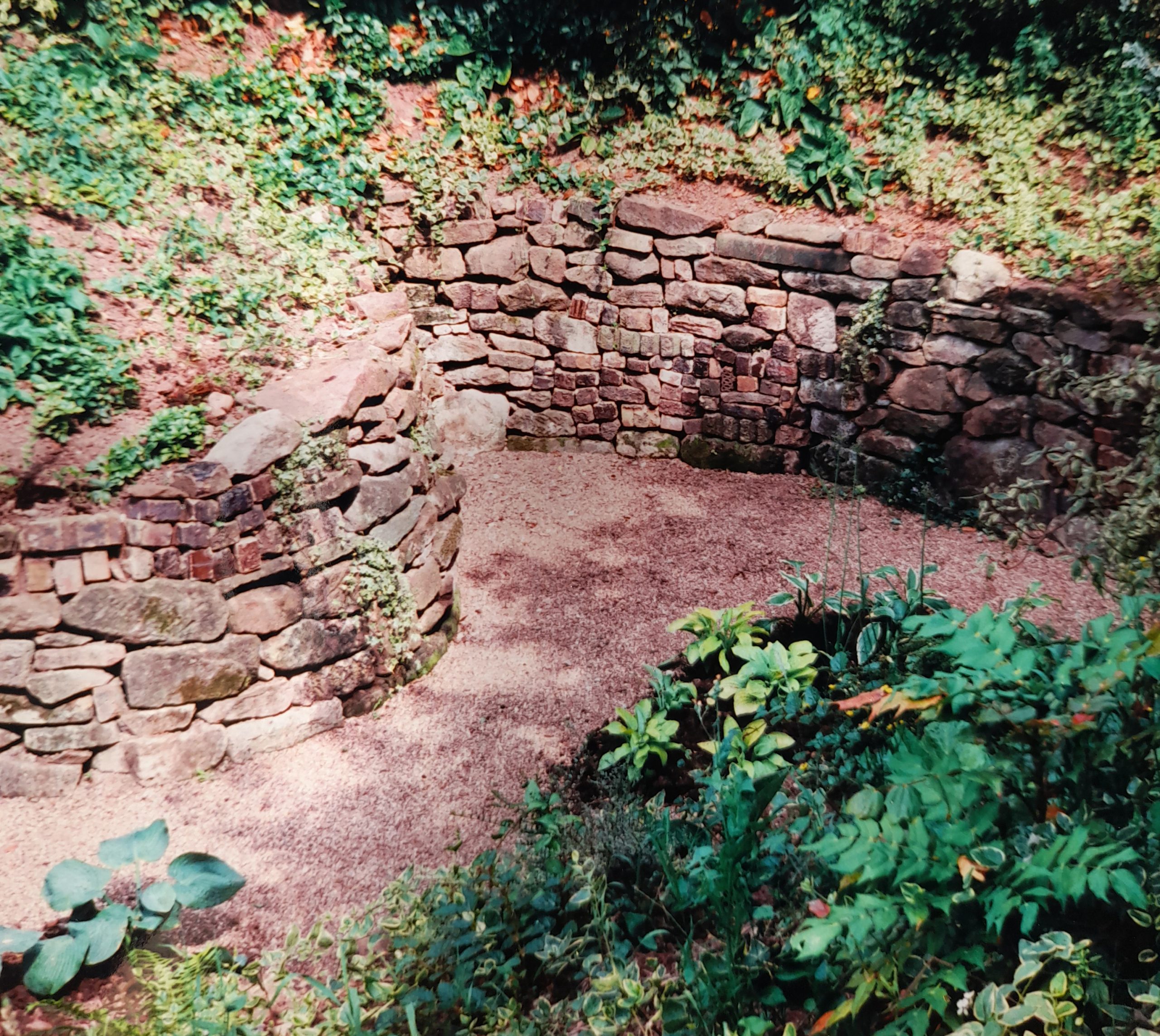
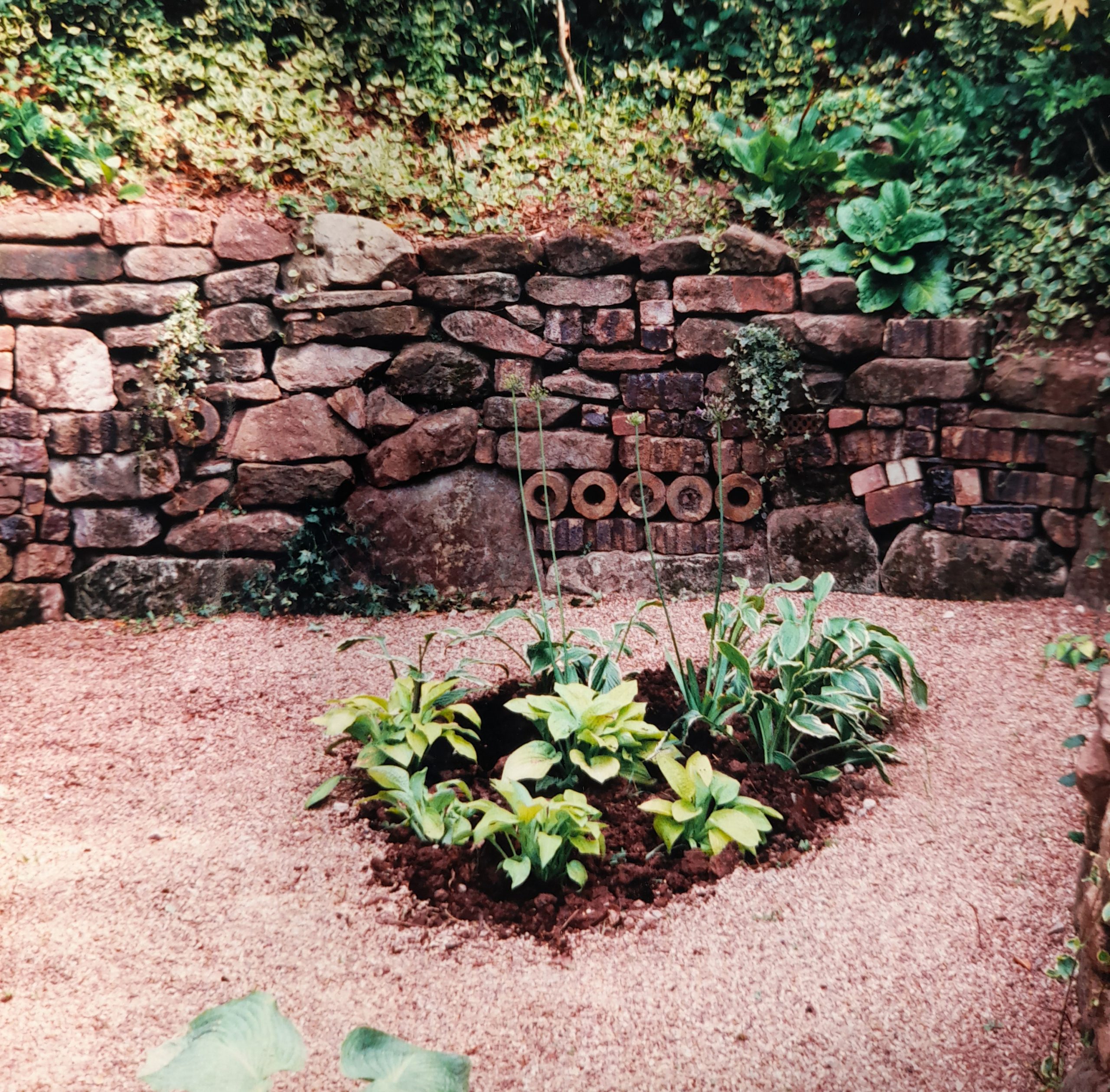

The project was to design and build a farmhouse garden for an ancient building in the Midlands. The site was literally covered in rubble from demolished buildings and various walls, together with a large number of brick ‘overburns’ – blocks of bricks formed as multiple units welded together during the firing process – land drains and other detritus. Rather than clearing this rubbish off site by means of grab lorries, I gained permission from the client to utilise as much material as possible.
Using a 3.5 ton excavator to shape the site, and create shallow foundations around the edges of the project, I started laying the reclaimed materials as they came to hand. In other words, I did not select any particular shape, size, colour or type of building material – but simply started to build vertical retaining walls with the next piece I touched.
As the walls progressed, both forward and upward, the stones/bricks/pipes etc were backed with strong wet concrete, rammed in behind to a width of approximately 150mm. With an average length/depth of each ‘stone’ @ 250mm, the wall was an average of 400mm thick, which was quite adequate to support the gentle slopes. (None of the ground behind was ‘made up’ or loose, and therefore no danger of any slippage or soil movement)
In order to add extra interest, the wall was designed to have no beginning and no end. Walking along and between the walls, there was no ‘terminal’, as the design just kept on flowing, with an approximate length of eighty linear metres, gently rising out of the ground as you enter the site, and disappearing back into the ground as you left…
Within a couple of days, the whole wall was a wildlife haven/hotel, with toads, mice, snails, beetles and just about every wild creature that could fit into the various nooks and crannies. The whole project took two men ten days, and the only materials used were cement and sandy ballast. (Plus, the floor surface material – 13mm peas shingle laid over compacted soil).